
A complete point-of-care system — from a handheld breath sampler to a compact analyzer to a calibrated AI risk report — delivered in under 15 minutes. No needles. No radiation. No specialist required.

The hardware exists and runs today. This is a live capture from the collection software — multiple deep-lung breaths accumulated into a single, volume-verified sample.
Imaging and lab-based analysis each carry barriers that cut access, accuracy, or both. BreathDX was designed to close every one of them.
CT and mammography detect a tumor that already exists. 85% of lung cancers are found at late stage, when survival drops sharply.
Polymer collection bags lose and add compounds — the sample analyzed isn't the sample collected — and cold-chain adds cost and failure points.
Gold-standard analysis (GC-MS) needs large, expensive, lab-bound equipment and trained chemists. eNose platforms trade away molecular specificity.
Electronic-nose devices read broad patterns with no molecular specificity — prone to diet and environmental confounders, with reported accuracy often at 70–80%.
Mammography and CT are centralized, costly ($100–$500+), and uncomfortable — creating access barriers and making frequent repeat screening a financial burden.
A fully integrated point-of-care sequence — from breath to clinical probability score — in any setting, no specialist required.
A handheld sampler captures multiple deep-lung breaths through a disposable mouthpiece. No prep, no discomfort.
The sample loads into the compact analyzer (~15 lbs), where target compounds are identified and quantified at sub-ppb sensitivity.
The BreathDX AI combines the VOC panel with patient risk factors to produce a single calibrated cancer probability.
A clear probability score with supporting evidence guides the decision: reassure, monitor, or refer — at the point of care.
BreathDX is a complete hardware-to-report system, purpose-built for point-of-care cancer screening — not software alone.
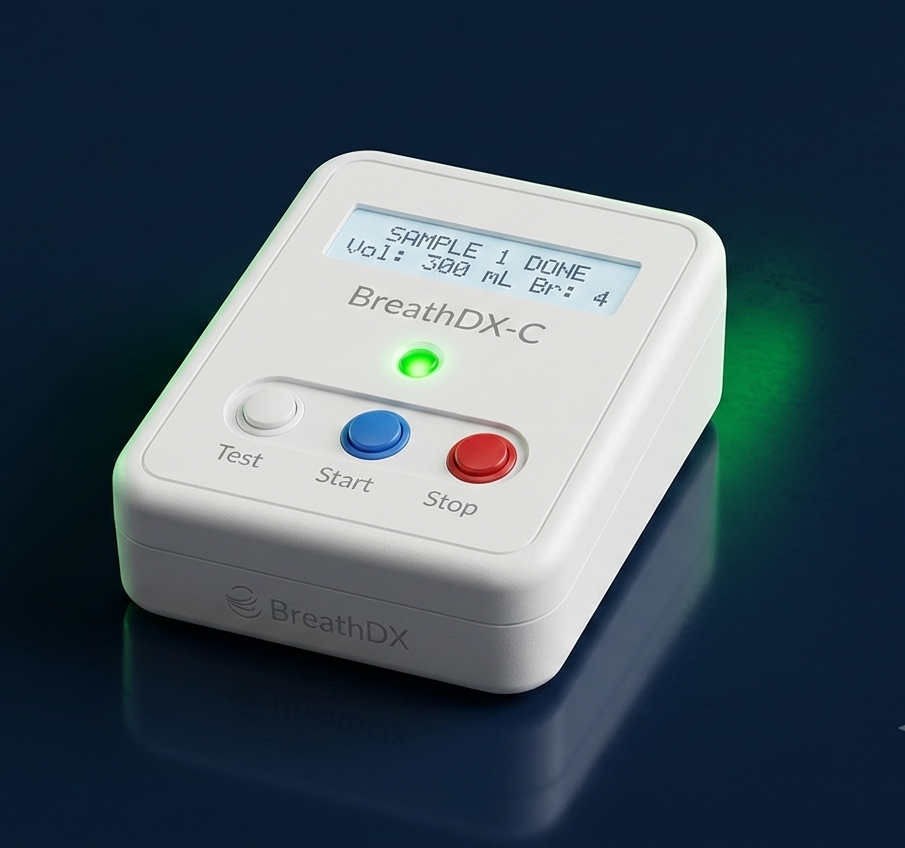
Battery-powered and guided, it accumulates multiple deep-lung breaths into one volume-verified sample, sealed for transport, storage, or on-site analysis.
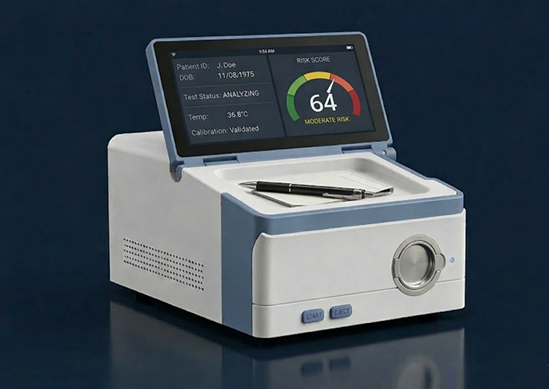
A compact desktop instrument (~15 lbs) built on AATG's proprietary detection technology, reaching the sensitivity needed to resolve cancer-associated VOCs. Screening and confirmation modes.
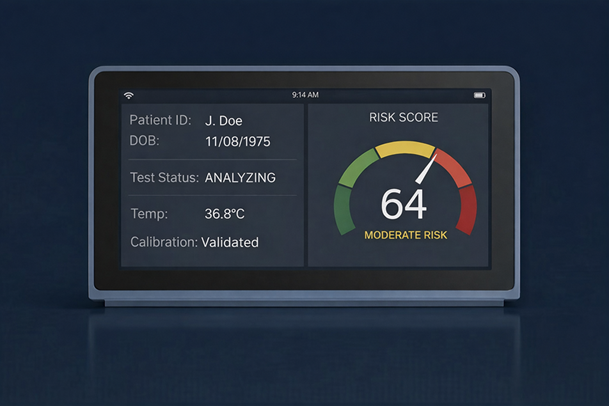
Software that turns VOC measurements into a calibrated cancer risk score — weighing patient demographics and clinical risk factors against evidence from hundreds of peer-reviewed studies.
Razor-and-blade economics. A hardware instrument sale to clinics plus recurring per-test consumable revenue (collection tubes, mouthpieces). Test cost is a fraction of mammography ($100–$250) or low-dose CT ($200–$500+), enabling broad adoption and high-volume throughput.
Current tools are expensive, invasive, slow, or out of reach for primary care. The platform closes every gap at once.
| Criterion | Low-dose CT | Bronchoscopy / biopsy | Blood-based tests | Other breath methods | BreathDX (AATG) |
|---|---|---|---|---|---|
| Invasiveness | Non-invasive | Highly invasive | Blood draw | Non-invasive | Exhaled breath only |
| Radiation | Yes — ionising | Minimal | None | None | Zero radiation |
| Time to result | Days–weeks | Days–weeks | Hours–days | Hours — varies | ~15 min, point-of-care |
| Cost per test | $200–$500+ | $1,500–$8,000+ | $100–$400 | Often research-only | Fraction of CT / mammography |
| Primary-care ready | No — specialist | No — hospital | Lab infrastructure | Research settings | Any clinical setting |
| Multi-disease | Single modality | Single site | Separate tests | Single-disease typical | LC + BC + expandable |
| Probability score | Radiologist reads | Pathologist reads | Positive / negative | Limited AI | AI probability score + report |
| IP position | Established | Established | Competitive | Publication-stage | Full system IP filed |
* R&D-stage platform. Cost and performance figures are projections based on published literature. Clinical validation studies are planned.
The biology of breath is public, peer-reviewed science. How we detect it, and how our model weighs it, is proprietary.
As cancer cells grow, altered metabolism generates volatile organic compounds (VOCs) that enter the bloodstream and are exhaled. BreathDX resolves a validated panel across multiple compound classes:
Specific biomarker identities are proprietary. Full panel available to qualified collaborators under NDA.
The model takes in measured biomarker readings and the patient's clinical risk factors, and returns a single calibrated probability — the way a clinician weighs several tests at once into one judgement.
Detection method and model internals are IP-protected. The demo below shows behaviour, not mechanism.
Set the clinical risk factors and biomarker readings — the calibrated probability updates in real time. Biomarker identities are anonymised (IP protected).
AATG's proprietary detection platform extends beyond diagnostics into security, defense, and pharmaceutical compliance.
High-sensitivity explosive trace detection for airports, venues, and critical infrastructure — with no radioactive source and no licensing burden.
Broad-spectrum detection of chemical warfare agents and toxic industrial compounds. Wearable, battery-powered, built for continuous field monitoring.
On-site cleaning-validation analyzer for pharmaceutical manufacturing — results in under a minute, replacing lab-based analysis and cutting downtime.
AATG's dedicated chemical-threat detection system for defense and public-safety deployment.
AATG has built a proprietary molecular-detection platform and is commercializing its first application — BreathDX — into two large, underserved screening markets, on a proven hardware-plus-consumable model.
We're actively seeking investment and strategic partners. Full biomarker panel, detection methodology, and AI pipeline are available to qualified collaborators and licensees under NDA.
We welcome clinical researchers, potential co-founders, investors, and SBIR/STTR program officers — on the breath platform or any AATG detection technology.
Send a message →